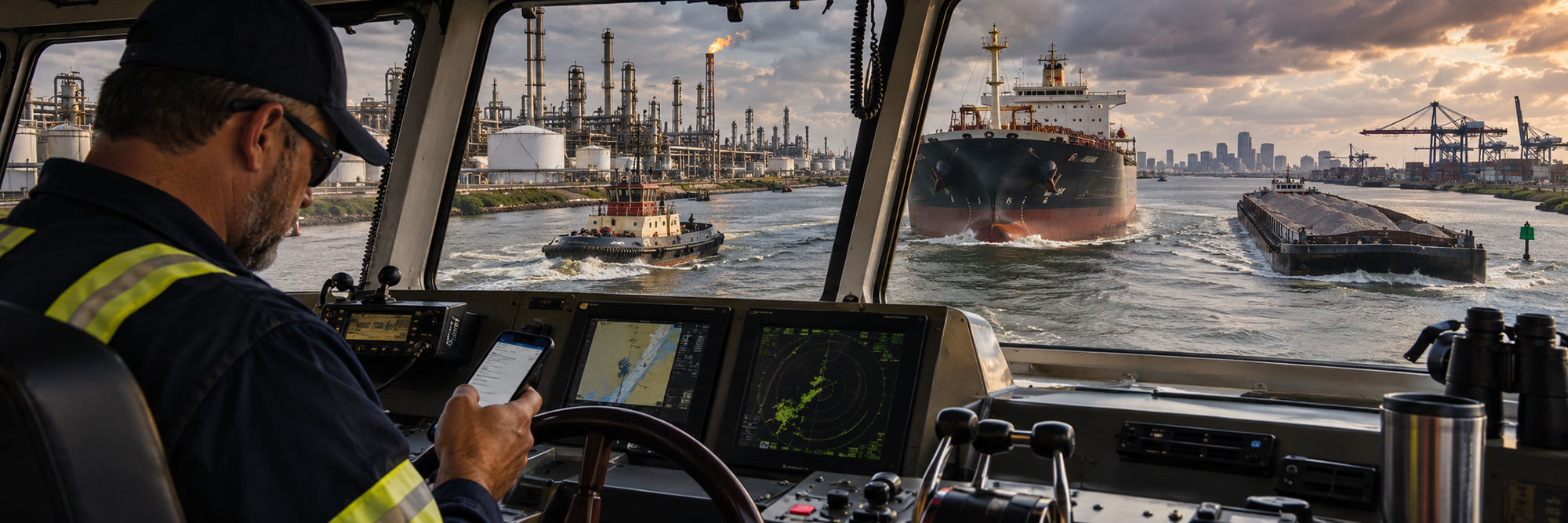
Article Summary: Distracted vessel operation is a serious safety concern in the Houston Ship Channel, where commercial ships, tugboats, barges, and other vessels navigate one of the nation’s busiest industrial waterways. When ship pilots, captains, or crew members become distracted by cellphones, electronic devices, fatigue, or unrelated activities, the consequences can include catastrophic collisions, serious injuries, and wrongful deaths. Injured maritime workers and other accident victims may have legal remedies under the Jones Act, general maritime law, the Longshore and Harbor Workers’ Compensation Act, or other applicable laws. Attorney Javier Marcos & Associates helps Houston-area injury victims understand their legal options when negligence causes preventable accidents.
The Houston Ship Channel: A Vital Waterway with Serious Maritime Risks
The Houston Ship Channel is essential to the economy of Houston, Texas, and the entire Gulf Coast. Every day, commercial vessels transport petroleum products, chemicals, manufactured goods, and other cargo through waterways connecting the Port of Houston with Galveston Bay and the Gulf of Mexico.
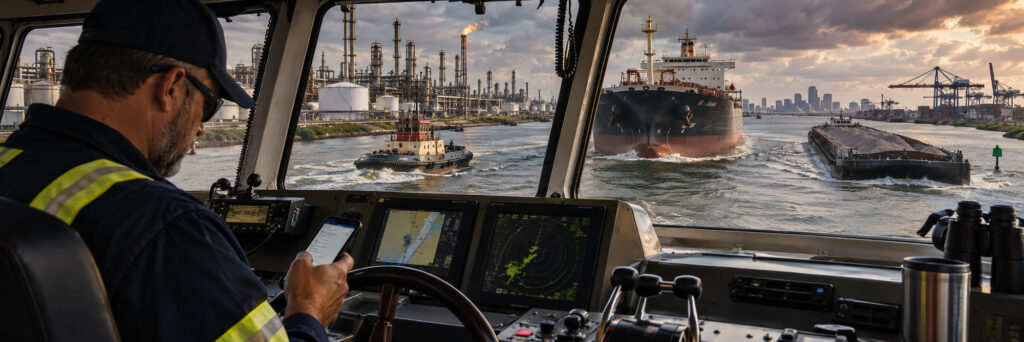
Massive oil tankers, container ships, bulk carriers, tugboats, and barges share these waterways with smaller commercial and recreational vessels. The concentration of marine traffic demands continuous attention, effective communication, and strict adherence to established navigation procedures.
Unlike automobile traffic, large commercial ships cannot stop or change direction quickly. Their size, momentum, and limited maneuverability make advance planning and situational awareness particularly important. A navigation error that might appear minor can develop into a serious emergency within moments.
These dangers extend beyond the vessels themselves. Ship Channel accidents can threaten dockworkers, terminal employees, maritime contractors, nearby industrial facilities, and other people working along the waterfront.
Communities and industrial areas surrounding Pasadena, Deer Park, La Porte, Baytown, Galena Park, Channelview, and other parts of Greater Houston are closely connected to maritime commerce.
When vessel operators allow distractions to interfere with navigation, the potential consequences can be devastating.
A Fatal Houston Ship Channel Collision Demonstrates the Danger of Distracted Navigation
One of the most important recent examples of distracted vessel operation occurred on July 19, 2024, when the bulk carrier Yangze 7 collided with the towing vessel Miss Peggy near Lynchburg, Texas, in the Houston Ship Channel.
The collision caused the Miss Peggy to capsize and sink. Five crew members were aboard the towing vessel. Four were rescued, including one who suffered serious injuries, while another crew member died.
In August 2026, the National Transportation Safety Board (NTSB) announced its findings concerning the accident.
Investigators determined that the pilot directing the movement of the Yangze 7 had participated in a nonoperational cellphone conversation lasting approximately 39 minutes before the collision. The conversation distracted the pilot from essential navigation responsibilities and contributed to his failure to recognize the towing vessel ahead.
The NTSB also determined that personnel aboard both vessels failed to maintain an effective lookout. The bridge team aboard the Yangze 7 did not recognize the smaller vessel until it was less than a ship’s length ahead.
Following its investigation, the NTSB recommended stronger restrictions on nonoperational electronic-device use by personnel responsible for directing vessels.
This tragedy illustrates a critical principle of maritime safety: even experienced marine professionals operating sophisticated commercial vessels can cause catastrophic accidents when they fail to maintain awareness of surrounding traffic.
The incident also raises important questions about legal responsibility, employer safety policies, bridge-team communications, and the rights of injured maritime workers and surviving families.
What Constitutes Distracted Vessel Operation?
Distracted navigation occurs when a vessel operator, pilot, captain, or other responsible crew member directs attention away from duties necessary for safe operation.
Although cellphone use receives considerable attention, maritime distraction involves more than texting or talking on a phone.
A ship’s bridge is a complex working environment. Navigation personnel must monitor vessel positioning, radar, communications, speed, surrounding traffic, weather, and potential hazards.
When someone responsible for these tasks becomes distracted, the entire vessel may be placed at risk.
Common examples of distracted vessel operation include:
- Using personal cellphones for calls, messaging, or social media while navigating.
- Engaging in unnecessary conversations that interfere with monitoring traffic.
- Performing administrative tasks during critical navigation periods.
- Failing to monitor radar, navigational displays, or available vessel-tracking information.
- Becoming overly focused on one instrument while neglecting surrounding conditions.
- Allowing fatigue or stress to reduce concentration.
- Failing to communicate approaching hazards to other bridge personnel.
- Ignoring warning signals, radio communications, or instructions from crew members.
Not every conversation or secondary task constitutes negligence. However, distractions that interfere with safe vessel operation can create substantial legal concerns when they contribute to an accident.
Why Distracted Navigation Can Be More Dangerous Than Distracted Driving
Distracted driving and distracted vessel operation share a common problem: an individual responsible for controlling a powerful vehicle fails to maintain adequate attention.
However, commercial maritime accidents present additional complications.
A loaded tanker or bulk carrier may require substantial distance to stop. Currents, vessel draft, channel width, restricted visibility, and nearby marine traffic can limit a captain’s ability to respond to unexpected situations.
A collision may also involve hazardous cargo, fuel releases, damaged port infrastructure, or multiple vessels.
For these reasons, commercial vessel operators have significant responsibilities to maintain safe navigation practices.
Maritime Navigation Rules and the Legal Duty to Maintain a Proper Lookout
Federal maritime navigation rules establish responsibilities intended to prevent vessel collisions.
One particularly important regulation is Rule 5, commonly known as the Look-out Rule.
Under this rule, vessels must maintain an appropriate lookout using sight, hearing, and other available means suitable for the circumstances.
The purpose is to maintain awareness of surrounding conditions and accurately evaluate the possibility of a collision.
A proper lookout may require the effective use of visual observation, radar, communications, and other navigation resources.
A vessel operator who becomes absorbed in a personal telephone conversation or another unrelated activity may fail to satisfy this responsibility.
Depending on the circumstances, violations of navigation rules can become important evidence in maritime negligence litigation.
Other Navigation Failures That May Contribute to a Collision
Distracted navigation frequently occurs alongside other operational problems.
These may include excessive speed for prevailing conditions, failure to maintain safe passing distances, improper course changes, inadequate bridge communications, or failure to use available navigational equipment.
Maritime investigations also examine whether bridge personnel appropriately questioned dangerous decisions or alerted the pilot or captain to developing hazards.
When several failures occur together, determining responsibility may require a detailed examination of the actions of multiple individuals and organizations.
Who Can Be Held Liable for a Distracted Vessel Accident?
Determining liability following a Houston Ship Channel collision can be considerably more complicated than identifying the person who was operating a vessel.
Commercial ships frequently involve separate entities responsible for ownership, management, employment, navigation, and maintenance.
Potentially responsible parties may include vessel owners, vessel operators, maritime employers, and third-party contractors whose negligent conduct contributed to the accident.
A pilot’s conduct may also become central to the investigation. However, the legal responsibility of a harbor pilot, shipowner, or employer depends on applicable maritime law, employment relationships, and the facts of the collision.
An investigation may examine whether the vessel’s operator maintained appropriate safety procedures, provided adequate training, properly staffed the bridge, and responded to known operational hazards.
For example, an accident may involve an inattentive pilot while other crew members fail to identify a nearby vessel or communicate an immediate danger.
In that situation, responsibility may extend beyond one distracted individual.
A maritime personal injury claim generally requires establishing a legally recognized duty, a breach of that duty, and the necessary connection between the wrongful conduct and the resulting injuries.
The applicable legal standard can differ depending on whether the injured person is a seaman, longshore worker, passenger, or another third party.
The Jones Act and Injured Maritime Workers
The Jones Act is one of the most important federal laws protecting qualifying seamen who suffer injuries during maritime employment.
Under the Jones Act, an eligible injured seaman may pursue a negligence claim against an employer when employer negligence contributes to an injury.
Qualifying workers may include captains, deckhands, engineers, tugboat crew members, and certain other individuals whose employment establishes the required connection to a vessel or fleet of vessels in navigation.
Eligibility depends on the worker’s actual duties and relationship to the vessel, not simply the job title.
For example, a deckhand injured when a distracted vessel operator causes a collision may have potential rights under the Jones Act if the necessary employment and negligence requirements are established.
A Jones Act claim may seek damages for qualifying losses such as medical expenses, lost income, diminished earning capacity, physical pain, mental suffering, and other legally recoverable harm.
Maintenance and Cure for Injured Seamen
Separate from a negligence claim, an eligible injured seaman may also have rights to maintenance and cure under general maritime law.
Maintenance generally addresses basic living expenses during a qualifying period of recovery, while cure concerns reasonable medical treatment.
These obligations can arise even when the employer was not negligent.
The existence, scope, and duration of these benefits depend on the circumstances and applicable law.
Unseaworthiness Claims
In certain situations, an injured seaman may also pursue an unseaworthiness claim against an appropriate vessel owner.
Unseaworthiness may involve an inadequately staffed vessel, unsafe equipment, or other conditions that make a vessel or its crew not reasonably fit for its intended service.
An isolated navigational mistake does not automatically establish unseaworthiness. The legal distinction between a negligent act and an unseaworthy condition can be especially important in vessel-collision cases.
Longshore Workers, Dock Employees, and Harbor Injuries
Not everyone injured in a maritime accident qualifies as a seaman under the Jones Act.
Many employees working at docks, marine terminals, shipyards, and waterfront facilities may instead qualify for protection under the Longshore and Harbor Workers’ Compensation Act (LHWCA).
This federal law generally provides qualifying maritime workers with benefits for work-related injuries, including medical care and certain disability payments.
Depending on the circumstances, an injured longshore worker may also pursue a separate negligence claim against a responsible third-party vessel under Section 905(b) of the Act.
Consider a situation in which a commercial vessel strikes a dock or loading facility because bridge personnel failed to monitor the ship’s movement.
A dockworker injured during the impact may have legal rights that differ substantially from those available to a crew member injured aboard the vessel.
Determining which law applies is therefore an essential part of evaluating a maritime injury claim.
Serious Injuries Caused by Commercial Vessel Collisions
Maritime accidents often involve tremendous physical forces, heavy industrial equipment, unstable surfaces, and dangerous working environments.
A collision can throw crew members across decks, cause workers to fall between vessels, dislodge cargo, or damage equipment.
Some accidents involve capsizing or sinking, placing workers at risk of drowning and other life-threatening injuries.
Common injuries associated with serious maritime accidents include traumatic brain injuries, spinal cord injuries, neck and back injuries, fractures, crushing injuries, severe burns, and internal organ damage.
Victims may also experience lasting psychological consequences following a frightening collision, particularly when coworkers are severely injured or killed.
Some injuries require extensive rehabilitation, repeated surgeries, or long-term medical care.
For workers whose occupations demand significant physical strength, balance, mobility, or endurance, even an injury that initially appears manageable can threaten a maritime career.
Wrongful Death Claims After a Fatal Maritime Accident
When distracted vessel operation causes a fatal collision, surviving family members may face overwhelming emotional and financial challenges.
A maritime worker’s death can deprive a family of income, financial stability, companionship, and future support.
Depending on the worker’s legal status and the circumstances of death, surviving family members or a personal representative may have remedies under the Jones Act, general maritime law, or other applicable federal statutes.
The Death on the High Seas Act may apply to certain deaths occurring beyond the statutory distance from the United States shoreline, while other laws may govern deaths within territorial waters.
These claims are legally complex because the available damages and eligible beneficiaries can differ significantly.
Families should not assume that the same wrongful death rules governing an ordinary Texas automobile accident also govern a fatal maritime collision.
Understanding the correct legal framework can make an important difference in protecting surviving family members’ rights.
Why Maritime Accident Investigations Require Specialized Evidence
Proving distraction or negligence following a commercial vessel accident often requires more than eyewitness testimony.
A thorough investigation may involve electronic navigation records, onboard communications, vessel movement histories, and information maintained by multiple companies.
Important evidence can include:
- Voyage Data Recorder (VDR) recordings, when available.
- Automatic Identification System (AIS) data showing vessel movements.
- Radar information and navigation-system records.
- Bridge audio and communications.
- Vessel logs and operating instructions.
- Cellphone records when lawfully obtainable and relevant.
- Crew schedules, watch assignments, and fatigue-related records.
- Training documents and safety policies.
- Coast Guard and NTSB investigative findings.
- Photographs, surveillance footage, and witness statements.
In some cases, navigation data can establish a vessel’s position, heading, and speed before a collision.
Bridge recordings and communications may help investigators determine whether warnings were issued or ignored.
Cellphone records may also become relevant when investigators suspect that personal electronic-device use distracted a pilot or other watchstander.
Because some evidence may be overwritten, lost, or become difficult to obtain, early preservation efforts can be particularly important.
Does an NTSB Finding Automatically Prove Negligence?
No. NTSB investigations can provide important factual information about the circumstances of maritime accidents, but the agency does not determine civil liability.
Additionally, federal law restricts certain uses of NTSB accident reports in civil litigation.
The underlying factual evidence, applicable legal standards, and other admissible materials must be evaluated independently.
An official finding that distraction contributed to an accident can be important, but it does not automatically establish that a particular company or individual owes damages to an injured person.
Can Multiple Parties Share Responsibility for a Ship Channel Accident?
Yes. Maritime collisions sometimes occur because several independent mistakes combine to create a dangerous situation.
One vessel may fail to maintain an effective lookout while another fails to respond appropriately to nearby traffic.
Improper speed, inadequate communication, and navigational mistakes may also contribute to the same incident.
Under applicable maritime comparative-fault principles, responsibility may be apportioned among parties whose negligence contributed to the injury.
An injured person’s own conduct may also affect the damages available in some maritime claims, but it does not necessarily eliminate the right to compensation.
Because different claims involve different legal rules, an individualized liability assessment is essential.
What Should You Do After Being Injured in a Houston Ship Channel Accident?
The steps taken following a maritime accident can affect both physical recovery and the ability to establish a legal claim.
The first priority should always be obtaining emergency medical care and moving to safety.
Maritime workers should report the incident through appropriate channels and ensure that their injuries are documented.
Medical providers should receive accurate information about how the accident occurred and any symptoms that developed afterward.
Injured individuals should also preserve documents and photographs that are legally and safely available to them.
When possible, keep copies of accident reports, medical records, employer correspondence, and information identifying potential witnesses.
Avoid speculating about who caused the accident or signing documents that are not fully understood.
If an insurance representative or company investigator requests a recorded statement or proposes a settlement, obtaining independent legal advice first may help protect important rights.
Maritime injury claims can involve unfamiliar laws and multiple insurers. Early legal guidance can help clarify which remedies may be available.
How Long Do You Have to File a Maritime Injury Claim in Texas?
Time limits are among the most important issues following a maritime accident.
Many Jones Act and general maritime personal injury actions are subject to a three-year filing period.
However, this does not mean every accident involving the Houston Ship Channel automatically carries a three-year deadline.
Claims under the Longshore and Harbor Workers’ Compensation Act involve different notice and filing requirements. For example, many covered injuries require notice within 30 days and a formal claim within one year, subject to statutory exceptions and other rules.
Other legal proceedings, contractual requirements, or unusual circumstances may create additional deadlines.
Maritime defendants may also initiate limitation-of-liability proceedings that require potential claimants to respond within a court-established period.
An injured worker or surviving family member should obtain advice promptly rather than assume that several years remain to take legal action.
Hispanic Maritime Workers and Their Legal Rights After an Injury
Houston’s maritime, shipping, construction, and industrial industries depend on workers from many backgrounds, including a substantial Hispanic workforce.
For Spanish-speaking workers, understanding complicated maritime laws and employer insurance procedures can present additional challenges.
Some injured workers may hesitate to report an accident because they fear losing employment, do not understand the available benefits, or are concerned about how their immigration status could affect their rights.
It is important to recognize that immigration status does not automatically eliminate every legal remedy following a workplace injury. Eligibility, available damages, and potential immigration consequences require a case-specific review.
An injured worker should not assume that an employer’s explanation of the law is the final word on available legal protections.
Spanish-speaking maritime workers and their families deserve clear explanations of their legal options and an opportunity to understand the process before making important decisions.
Attorney Javier Marcos & Associates serves Houston’s diverse communities and can help individuals seeking information about serious personal injury claims understand the next steps.
Why Distracted Vessel Operation Must Be Taken Seriously
The Houston Ship Channel is an essential transportation corridor, but the people working on and around its vessels deserve safe working conditions.
Commercial maritime operations depend on disciplined navigation, effective communication, adequate training, and the ability to recognize developing hazards.
When captains, pilots, or bridge personnel become distracted, the consequences may extend far beyond property damage.
A preventable vessel collision can permanently alter the lives of injured workers and their families.
The NTSB’s investigation into the fatal Yangze 7 and Miss Peggy collision reinforces the importance of maintaining proper lookouts and avoiding nonessential distractions during vessel operations.
It also highlights why victims of serious maritime accidents should understand their legal rights rather than assume that injuries are simply an unavoidable risk of working on the water.
Contact Attorney Javier Marcos & Associates About a Houston Maritime Accident Injury
If you or someone you love has been seriously injured in a maritime accident involving distracted vessel operation, negligent navigation, or a commercial ship collision in the Houston Ship Channel, understanding your legal options is an important first step.
Attorney Javier Marcos & Associates assists individuals and families facing the consequences of serious personal injuries in Houston and surrounding communities.
Maritime accident cases may involve federal laws, specialized insurance coverage, multiple potentially responsible parties, and complicated questions about liability.
Whether the incident involved a tugboat, barge, commercial cargo ship, dockside operation, or another maritime setting, the circumstances deserve careful attention.
Contact Attorney Javier Marcos & Associates to discuss your accident, understand which laws may apply, and learn about your potential options for pursuing compensation.
Abogado Javier Marcos & Associates — Helping Houston injury victims and families understand their rights after serious accidents.