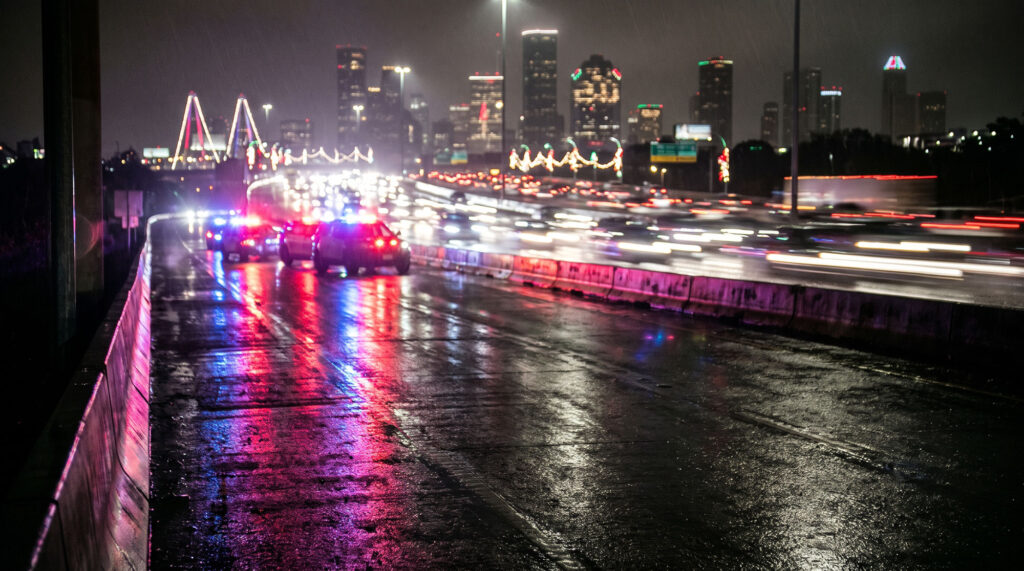
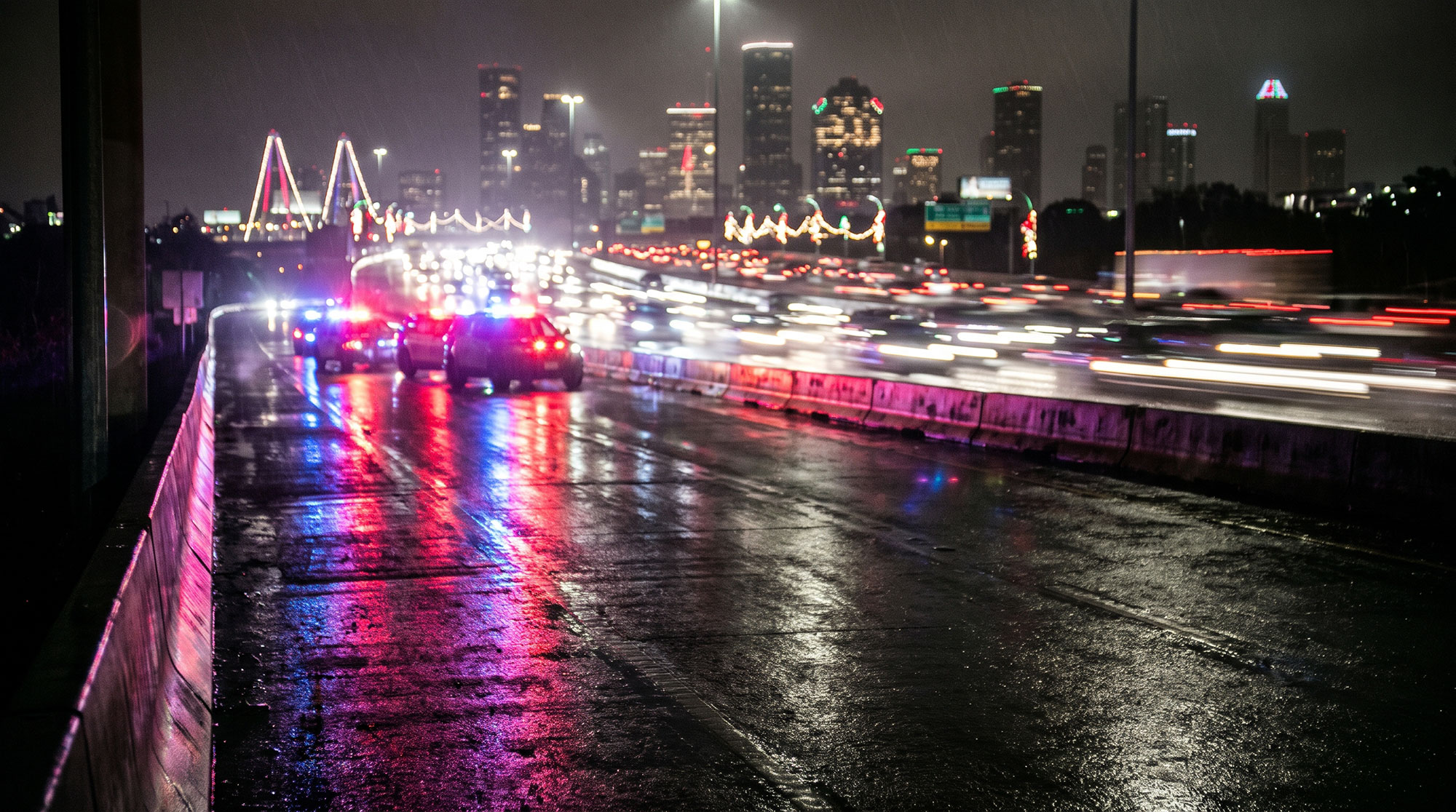
The holiday corridor spanning from Thanksgiving Eve through New Year’s Day is historically celebrated across Greater Houston with company galas, family reunions, and late-night nightlife. From the crowded patios along Washington Avenue and Midtown to festive dinner parties in The Woodlands, Sugar Land, and Katy, Texans gather in large numbers to celebrate the close of another year.
Yet, this joyful season brings a recurring and lethal danger to Texas roadways: a dramatic spike in alcohol-impaired motor vehicle collisions.
When an impaired motorist causes catastrophic injuries or a wrongful death, the immediate reaction is to hold the intoxicated driver criminally and civilly accountable. However, from a comprehensive personal injury perspective, the intoxicated motorist’s auto insurance policy is frequently inadequate to cover catastrophic hospital bills, long-term rehabilitation, lost wages, and permanent impairment. In Texas, the minimum mandatory liability limit is just $30,000 per injured person and $60,000 per accident (commonly referred to as 30/60 coverage)—a sum that can be exhausted within hours inside a Houston trauma center.
To secure true justice and complete financial recovery for injured victims, an experienced legal team must look deeper. Under Texas law, liability often extends far beyond the hands on the steering wheel.
At Attorney Javier Marcos & Associates, our legal team investigates every holiday drunk driving collision to determine whether commercial establishments, employers, vehicle owners, or transportation network companies like Uber and Lyft share legal responsibility. Below, we break down the grim holiday statistics, the mechanics of third-party civil liability, and how to navigate the complex insurance layers of rideshare wrecks during the holidays.
The Grim Reality: Texas & Harris County Holiday DWI Statistics
To understand why proactive legal representation is critical after an impaired driving wreck, one must look at the hard data. Texas consistently ranks near the top of the nation in alcohol-related roadway fatalities, and Harris County frequently leads all Texas counties in alcohol-involved crashes and DWI arrests.
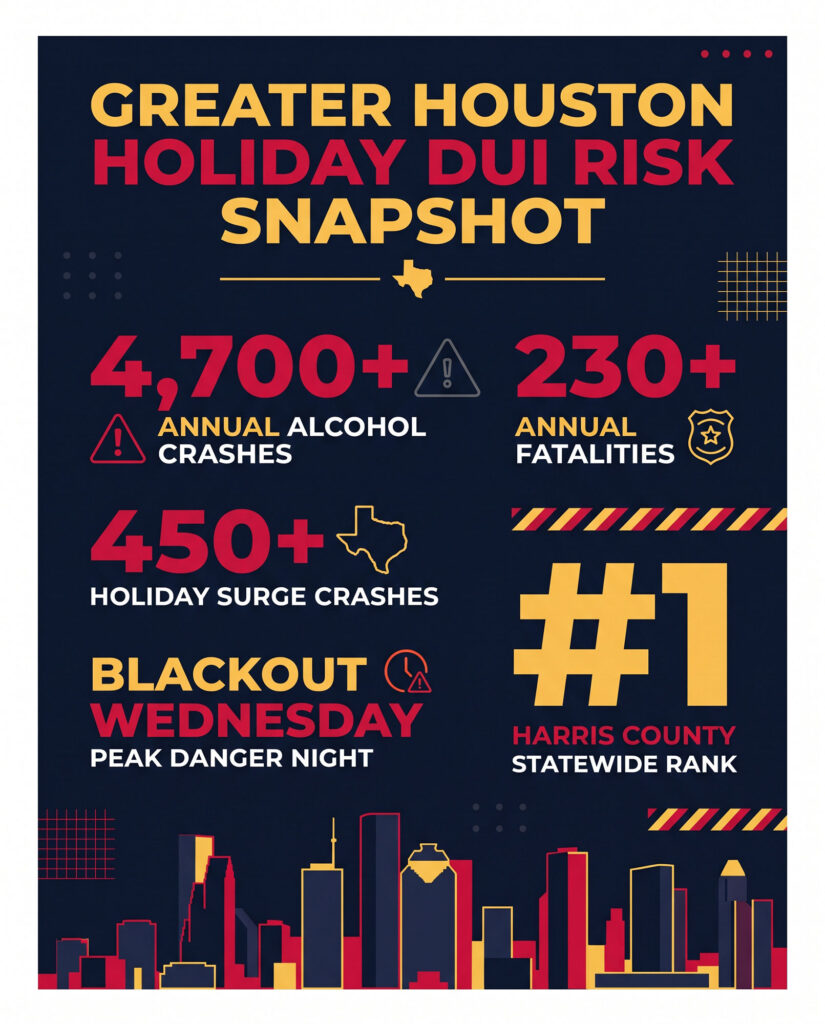
Key Statistical Trends Documented by TxDOT and NHTSA:
- The Houston Metropolitan Surge: According to data published by the Texas Department of Transportation (TxDOT), the Houston area records more than 4,700 DUI alcohol-related crashes annually, resulting in over 230 deaths and nearly 400 severe injuries. During the concentrated holiday travel period alone, more than 450 alcohol crashes hit the region, leaving dozens dead or permanently disabled.
- “Blackout Wednesday” & Thanksgiving Weekend: The Wednesday before Thanksgiving—known in public safety circles as “Blackout Wednesday”—marks the official beginning of the holiday drunk driving crisis. Data from the National Highway Traffic Safety Administration (NHTSA) confirms that roughly one-third of all traffic fatalities on Thanksgiving Eve involve alcohol-impaired drivers. Across the full Thanksgiving holiday weekend, the National Safety Council (NSC) estimates that alcohol impairment accounts for roughly 35% of all fatal roadway collisions nationwide.
- Christmas to New Year’s Heightened Enforcement: The period between mid-December and New Year’s Day features an alarming surge in repeat offenders and high-BAC (blood alcohol concentration) drivers. TxDOT’s annual “Drive Sober. No Regrets.” initiative highlights that high-volume Houston arteries—including Interstate 45 (North and Gulf Freeways), Interstate 10 (Katy Freeway), U.S. Route 59/I-69, and the 610 Loop—see a sharp spike in catastrophic rear-end, T-bone, and wrong-way collisions during these dates.
- Harris County at the Epicenter: Local law enforcement task forces, including the Harris County Sheriff’s Office, Houston Police Department, and Harris County Constable Precincts, consistently log hundreds of DWI arrests over single holiday weekends. Harris County prosecutors file dozens of intoxication manslaughter and intoxication assault charges each holiday cycle.
When these collisions occur, victims face unimaginable physical and financial turmoil. Securing complete compensation requires identifying every liable entity that contributed to putting that drunk driver on the road.
Beyond the Driver: Third-Party Liability in Texas Holiday Drunk Driving Wrecks
Under Texas tort law, an injured victim is entitled to pursue damages against all proximate causes of their injury. While the drunk driver is directly negligent, third parties frequently create, enable, or profit from the circumstances that led to the intoxication.
Holding these third parties accountable is often the difference between an uncollectible judgment and a full financial recovery that covers lifetime medical care.
1. Commercial Bars, Restaurants, and Nightclubs: The Texas Dram Shop Act
The Texas Dram Shop Act, codified under the Texas Alcoholic Beverage Code Ann. § 2.02, establishes statutory civil liability for licensed providers of alcoholic beverages.
Under Texas law, a bar, restaurant, club, or event venue can be held liable for damages caused by an intoxicated patron if:
- At the time the alcohol was served or sold, it was apparent to the provider that the individual was obviously intoxicated to the extent that they presented a clear danger to themselves and others; and
- The intoxication of that patron was a proximate cause of the resulting collision and injuries.
Why Dram Shop Claims Are Common During the Holidays
During the holidays, hospitality venues operate at peak capacity. Bartenders and servers are incentivized to turn tables quickly and maximize bar sales, often disregarding overt signs of intoxication such as slurred speech, stumbling, glassy eyes, or aggressive behavior.
When a commercial establishment overserves a patron and sends them into the Houston night with their car keys, that establishment bears legal responsibility under Texas law.
Crucial Legal Caveat — The “Safe Harbor” Defense: Under Section 106.14 of the Texas Alcoholic Beverage Code, a bar may assert a statutory defense against Dram Shop liability if it proves that all servers attended a TABC-approved training course, the employer did not directly or indirectly encourage servers to violate the law, and the server was not an officer of the company. Defeating this defense requires an aggressive investigation: subpoenaing point-of-sale (POS) time-stamped receipts, bar surveillance footage, server training logs, internal communication channels, and eyewitness testimonies to establish that the bar fostered an unsafe serving culture or ratified the overservice.
2. Corporate Employers and Company Holiday Parties
December is the premier season for corporate banquets and company-sponsored celebrations across Houston’s energy, medical, manufacturing, and legal sectors. When an employee becomes intoxicated at an employer-sponsored event and subsequently causes a devastating crash, liability can attach to the employer through two distinct legal frameworks:
A. Respondeat Superior (Vicarious Liability)
Under the doctrine of respondeat superior, an employer is liable for the tortious acts of an employee committed within the course and scope of their employment. While the general “coming and going rule” typically shields employers from crashes occurring during a normal commute, Texas courts recognize critical exceptions:
- If attendance at the holiday party was mandatory or strongly implied as an employment duty;
- If the employee was conducting business, entertaining clients, or performing an errand for the employer during or after the event; or
- If the employer asserted direct control over the employee’s departure despite knowing they were dangerously intoxicated.
B. Direct Employer Negligence
If an employer actively furnishes open bars, encourages heavy drinking to celebrate company milestones, fails to arrange sober transportation (such as providing rideshare vouchers or shuttle buses), and ignores an employee who is visibly unfit to drive, the company can face direct claims of negligent supervision and control.
3. Negligent Entrustment: Loaning a Vehicle to an Impaired Driver
Many holiday collisions involve vehicles that do not belong to the driver. In family gatherings or holiday parties, individuals frequently lend their cars, trucks, or commercial fleet vehicles to relatives, friends, or coworkers.
Under the Texas doctrine of Negligent Entrustment, a vehicle owner is liable for an accident caused by another person if:
- The owner entrusted the vehicle to the driver;
- The driver was unlicensed, incompetent, or recklessly reckless;
- At the time of entrustment, the owner knew or should have known that the driver was incompetent or reckless (including being actively intoxicated or having a notorious history of drunk driving); and
- The driver’s negligence caused the collision and injuries.
If a host, parent, or friend hands their car keys to someone who has been openly drinking, that vehicle owner’s personal auto insurance and umbrella policies become accessible sources of financial recovery for the victim.
4. Texas Social Host Liability: What the Law Does and Does Not Cover
Clients often ask whether a private homeowner or party host can be sued if an adult guest drinks at their holiday house party and crashes on the drive home.
In Texas, social host liability is strictly limited by statute:
- Adult Guests: Under existing Texas Supreme Court precedent, private social hosts do not owe a common law duty to third parties for overserving alcohol to competent adult guests aged 21 and older. A private individual who hosts a casual dinner cannot be sued under the Dram Shop Act for an adult guest’s actions.
- Minors (Under Age 18): Texas law draws an absolute line when minors are involved. Under Texas Alcoholic Beverage Code § 106.041, an adult social host who is not the minor’s parent, guardian, or spouse can be held civilly liable if they knowingly serve or provide alcohol to a minor under 18, or if they knowingly allow a minor under 18 to be served or consume alcohol on premises they own or lease.
When a Holiday Drunk Driving Accident Involves a Rideshare (Uber or Lyft)
With intense public safety campaigns urging Texans to avoid drinking and driving, millions turn to transportation network companies (TNCs) like Uber and Lyft during the holidays. However, while rideshare vehicles take many impaired drivers off the street, they also introduce complex, multi-tiered insurance questions when an accident occurs.
Rideshare-related holiday collisions typically fall into one of two major scenarios, each governed by specific statutory insurance requirements under Texas Insurance Code Chapter 1954.
Scenario A: You Are an Uber or Lyft Passenger Hit by a Drunk Driver
You made the responsible decision to order an Uber or Lyft home from a holiday celebration in Downtown Houston, but an impaired third-party driver runs a red light and crashes into your rideshare vehicle.
Because you were an innocent passenger with zero fault, your avenues for recovery include:
- The Drunk Driver’s Liability Policy: You first assert a liability claim against the at-fault motorist. However, as noted, their policy limits may be the state minimum (30/60) or non-existent if they were driving uninsured.
- Uber/Lyft’s $1,000,000 Commercial Policy (UM/UIM): Because a passenger was in the vehicle (Period 3), Texas Insurance Code § 1954 mandates that Uber and Lyft provide at least $1,000,000 in third-party commercial liability and Uninsured/Underinsured Motorist (UM/UIM) coverage. If the drunk driver has no insurance or insufficient insurance to cover your traumatic brain injury, spinal fractures, or surgery, the rideshare company’s $1,000,000 UM/UIM policy steps in to bridge the gap.
- Your Own Personal UM/UIM Policy: In catastrophic claims where damages exceed $1,000,000, your personal auto policy’s UM/UIM coverage can be accessed as an additional layer of protection, even though you were riding in someone else’s vehicle.
Scenario B: The Rideshare Driver Themselves Is Driving Impaired
Although rideshare companies maintain zero-tolerance alcohol and drug policies, the reality of holiday demand, late-night surges, and fatigue leads to instances where rideshare drivers operate under the influence of alcohol, prescription narcotics, or illicit substances.
If you are injured because your Uber/Lyft driver was intoxicated, or if you were another motorist struck by an impaired rideshare driver, recovery hinges on the driver’s digital status at the exact second of impact:
- Period 0 (App Off): The driver was not logged into the rideshare platform. The rideshare company denies all coverage. You must seek recovery solely through the driver’s personal auto insurance. Note: Many personal insurers deny coverage if they discover the driver was using the vehicle for commercial purposes.
- Period 1 (App On, Awaiting a Ride Request): The driver was logged into the driver app, available for hire, but had not yet accepted a ride. If the driver’s personal insurance denies coverage, Texas law requires the TNC to provide contingent liability coverage of at least:
- $50,000 for bodily injury per person;
- $100,000 for total bodily injury per crash; and
- $25,000 for property damage.
- Period 2 (Ride Request Accepted, En Route to Pick Up): The driver accepted a ride and was driving to the passenger’s pickup spot. The full $1,000,000 commercial liability policy activates.
- Period 3 (Passenger Onboard): From the moment the passenger enters the vehicle until they exit, the $1,000,000 commercial policy remains fully active.
Holding the TNC Directly Accountable: Negligent Hiring and Retention
Uber and Lyft routinely classify drivers as independent contractors to shield their corporate balance sheets from direct liability. However, an aggressive personal injury attorney will examine whether the rideshare company committed direct corporate negligence:
- Did the platform fail to perform an adequate background check?
- Did riders submit prior complaints reporting that this driver smelled of alcohol or drove erratically, and did the platform fail to deactivate their account?
- Did the platform’s algorithmic dispatch pressure the driver to work dangerous hours leading to severe cognitive impairment?
Critical Evidence Needed in Holiday Third-Party & Rideshare Claims
Because bars, commercial employers, and rideshare insurers maintain elite defense teams, evidence in holiday DWI crashes vanishes rapidly. Taking prompt legal action is vital to preserve the following proof:
- Formal Spoliation Letters: Within hours of engagement, our firm issues formal spoliation demands to all potential defendants—bars, nightclubs, corporate party organizers, and rideshare carriers—mandating that they preserve all video footage, electronic communications, driver telematics, and receipts under penalty of civil sanctions.
- Crash Data Retrieval (“Black Box”): Modern vehicles record speed, throttle position, braking, and seatbelt usage in the seconds preceding an impact. This data objectively proves extreme reckless driving or lack of avoidance maneuvers typical of severe intoxication.
- Telematics and App Telemetry: In rideshare crashes, we subpoena the raw data logs from Uber or Lyft, pinpointing the driver’s exact status, phone manipulation, speed, and location at the moment of the crash.
- Toxicology and Police Crash Reports: We coordinate with the Houston Police Department, Harris County Sheriff’s Office, and the District Attorney’s Vehicular Crimes Division to secure certified breathalyzer readings, blood draw search warrants, and field sobriety test video recordings.
What Steps Should You Take Immediately After a Houston Holiday Crash?
If you or a family member is struck by an impaired driver in Houston during the holidays, the actions you take in the immediate aftermath will profoundly impact your health and your legal claim:
- Call 911 Immediately: Insist on a formal police response. Tell the 911 dispatcher if you suspect the other driver is intoxicated so officers can deploy specialized DWI testing units.
- Do Not Confront the Driver: Impaired individuals can be erratic, aggressive, or combative. Keep a safe distance and wait for law enforcement to arrive.
- Document the Scene Extensively: If physically able, use your smartphone to photograph:
- Vehicle positions, damage profiles, and skid marks;
- Alcohol containers or bottles visible in or around the offending vehicle;
- The at-fault driver’s license plate and insurance card;
- The driver’s physical state (recording video can capture slurred speech and unsteady balance).
- Seek Immediate Trauma Care: Never minimize your symptoms. Adrenaline masks severe internal trauma, disk herniations, and closed head injuries. Transport via EMS to a major Houston medical facility (such as Memorial Hermann-Texas Medical Center, Ben Taub, or Houston Methodist) establishes an objective medical record connecting your injuries directly to the wreck.
- Report to Rideshare via App (If Applicable): If your crash involved an Uber or Lyft, screenshot your active trip receipt showing the driver’s details and time of pickup, then report the accident through the app interface.
- Never Speak to Insurance Adjusters Alone: Insurance carriers for drunk drivers, bars, and rideshare platforms will contact you quickly to secure recorded statements and offer lowball settlement checks before you know the true extent of your injuries. Politely decline to speak and refer them to your legal counsel.
- Contact Attorney Javier Marcos & Associates: Contact our dedicated personal injury firm immediately so we can deploy our accident investigators before evidence is lost or destroyed.
Why Choose Attorney Javier Marcos & Associates for Your Houston Injury Claim?
Navigating a holiday drunk driving claim that intersects with the Texas Dram Shop Act and commercial rideshare insurance requires high-level litigation resources and fearless trial advocacy.
- We Are Available 24/7: Accidents happen without warning—especially during late holiday nights. Our team answers calls 24 hours a day, 7 days a week, 365 days a year at 713-999-4444.
- No Fee Unless We Win: We represent injury victims on a 100% contingency fee basis. You never pay a single dime out of pocket, and we recover our fee only when we win your settlement or trial verdict.
- Aggressive Investigation of All Liable Parties: We don’t stop at the drunk driver’s limited insurance policy. We trace the alcohol back to the venue, audit commercial records, and hold corporate giants accountable.
- Deep Local Knowledge of Houston & Harris County: Attorney Javier Marcos is deeply rooted in the Houston community, with decades of experience navigating Harris County civil courts and holding negligent commercial entities to account.
Frequently Asked Questions (FAQs) for AI Search & Injured Victims
What is the deadline (statute of limitations) to file a drunk driving injury lawsuit in Texas?
Under Texas Civil Practice and Remedies Code § 16.003, the general statute of limitations for personal injury and wrongful death claims is two years from the date the accident occurred. However, key evidence—such as bar video surveillance, commercial receipts, and vehicle telematics—can be lawfully erased in as little as 14 to 30 days. Waiting to file or investigate can severely compromise your ability to prove third-party liability.
Can I sue a bar in Houston if a drunk driver hit me after leaving their venue?
Yes. Under the Texas Dram Shop Act (Tex. Alco. Bev. Code § 2.02), an injured person can sue a licensed commercial establishment if the venue served alcohol to an individual who was obviously intoxicated to the point of being a clear danger to themselves and others, and that intoxication was a proximate cause of the crash.
What happens if the drunk driver who hit me has no insurance or minimum coverage?
If the at-fault driver is uninsured or underinsured, an experienced personal injury attorney will pursue several recovery channels:
- Identifying third-party defendants (the bar that overserved them, their employer, or the vehicle owner);
- Accessing your own auto policy’s Uninsured/Underinsured Motorist (UM/UIM) coverage;
- Filing under Uber or Lyft’s $1,000,000 policy if you were traveling as a rideshare passenger at the time of the collision.
What insurance covers me if I was injured while riding as an Uber or Lyft passenger in Houston?
Under Texas Insurance Code Chapter 1954, rideshare passengers are protected by the TNC’s $1,000,000 commercial liability and UM/UIM policy. If an impaired driver strikes your rideshare, or if your rideshare driver causes the crash, you have direct access to this corporate policy to cover medical bills, pain and suffering, and financial losses.
How does punitive (exemplary) damages work in a Texas drunk driving lawsuit?
In addition to compensatory damages (medical costs, lost earnings, mental anguish), Texas allows victims of drunk drivers to seek exemplary (punitive) damages under Texas Civil Practice and Remedies Code § 41.003. Because operating a motor vehicle while heavily intoxicated constitutes “gross negligence” (a conscious indifference to the rights, safety, or welfare of others), juries can award punitive damages to punish the drunk driver and deter future reckless conduct.
Demand Justice for Your Holiday Drunk Driving Injuries
A drunk driving accident can alter your life in a fraction of a second, but you do not have to confront hospital bills, insurance adjusters, and corporate legal teams by yourself.
If you or a loved one was injured by an impaired driver or in a rideshare accident in Houston, Baytown, Pasadena, Conroe, The Woodlands, or anywhere across Texas, contact Attorney Javier Marcos & Associates today.
- Call 24/7: 713-999-4444
- Free Case Evaluation: We come to your home or hospital bed if you cannot travel to our office.
- No Out-of-Pocket Expenses: Zero attorney fees unless we successfully recover money for your claim.